
Jaisalmer’s palace hotels keep Rajasthani culture alive in a few very practical ways. They’re built and repaired by local stone carvers. They give hereditary musicians regular, paid work. They fill their rooms with textiles woven and printed in the region, and they keep slow, old desert recipes on the menu when it would be far easier to drop them.
That’s the short version. Some hotels do this well and some mostly put on a show, so it’s worth understanding what’s going on behind the scenes, and why it matters to the people of Jaisalmer as much as it does to the guests.
Why hotels ended up carrying this at all
For centuries, culture in western Rajasthan ran on patronage. Rajput families kept musicians attached to their households, paid carvers to decorate their havelis and fed whole kitchens of cooks who knew recipes nobody wrote down. Nobody bought a ticket for any of it. Music, carving and cooking were simply part of how a noble household ran.
That system thinned out after independence, as the princely states merged into India, and it took another blow in 1971 when the privy purses paid to former rulers were abolished. A lot of the money that had quietly supported musicians and craftsmen simply stopped coming in.
Tourism in Rajasthan filled part of that gap, and in a city like Jaisalmer the palace hotel became one of the new patrons. A hotel’s priorities aren’t a royal household’s, of course, and the fit isn’t perfect. Still, for many artisan families today, hotel work is one of the steadiest sources of income.
It starts with the Stone
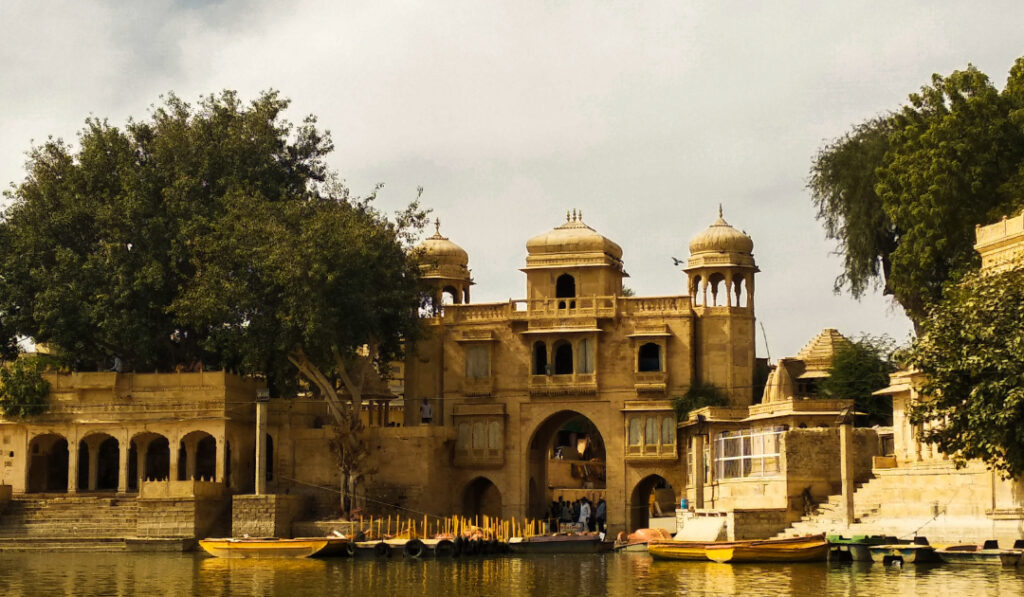
Almost everything in Jaisalmer is built from the same honey-yellow colored sandstone, quarried locally, and it’s the reason the whole city glows the way it does at sunset. The stone is soft enough to cut into screens so fine they look like lace, which is exactly what you see on the facades of Patwon ki Haveli and Salim Singh ki Haveli.
The people who do this work are the stone carvers of Jaisalmer, families who’ve passed the skill from father to son for generations. Their craft only survives if someone keeps commissioning it. A new building in cement, concrete and glass doesn’t need these people. A building designed in the old idiom needs these craftsmen twice: once to carve it, and then again, year after year to maintain it because desert wind and sand slowly wear the details down.
The forms themselves had a job to do. Jharokhas, the carved overhanging windows, throw shade and pull in cooler air. Thick stone walls trap the cool of the night well into the afternoon. Central courtyards give a household somewhere to gather once the heat breaks. A palace hotel that keeps these elements is keeping an entire way of building for the desert.
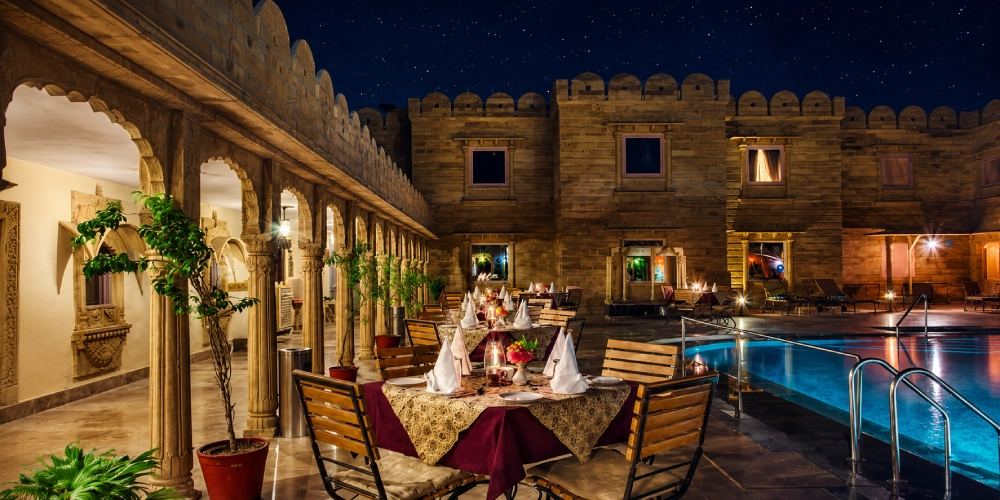
Fort Rajwada was built like a traditional Rajasthani fort with the help of these experienced craftsmen, with hand-carved sandstone facades, latticed jharokhas and arched windows. The hotel has been open since 1998, and when it was reimagined in 2021, that fort architecture stayed at the heart of it. Its Central Courtyard still does what courtyards have always done in Rajasthan, hosting gatherings and, these days, wedding pheras.
Giving musicians a reason to keep playing
The Manganiyars of Jaisalmer and Barmer are hereditary Muslim musicians whose families sang for Rajput patrons, their jajmans, for generations. They performed at births and weddings and kept the patron family’s history alive with the songs. The folklorist Komal Kothari spent decades documenting their music and helping bring it to wider audiences through his institute, Rupayan Sansthan.
When the old patrons faded, many younger musicians had a hard choice to make. The songs are learned by ear, over years, and you can’t keep that up if the music doesn’t pay. Some families have found work at national and international festivals. Far more depends on what’s closer to home like weddings, private events and regular evenings at hotels.
That’s where a palace hotel really matters. A steady booking lets a father keep teaching his son traditional music. It keeps instruments like the kamaicha in use, and there aren’t many people left who know how to build one.
There’s a difference, though, between supporting a tradition and using it as background noise. At the better hotel evenings, musicians get to sing their own repertoire instead of the same three crowd-pleasers on repeat. They’re introduced by name, and the music gets a proper setting where guests sit and listen.
At Fort Rajwada, live folk music and dance performances are organised at the property, and the in-house events team arranges folk evenings and camel processions for weddings. If you’re staying, sit close, ask the musicians where they’re from, and you’ll usually get a story along with the next song.
Textiles, crafts and the things you sleep under
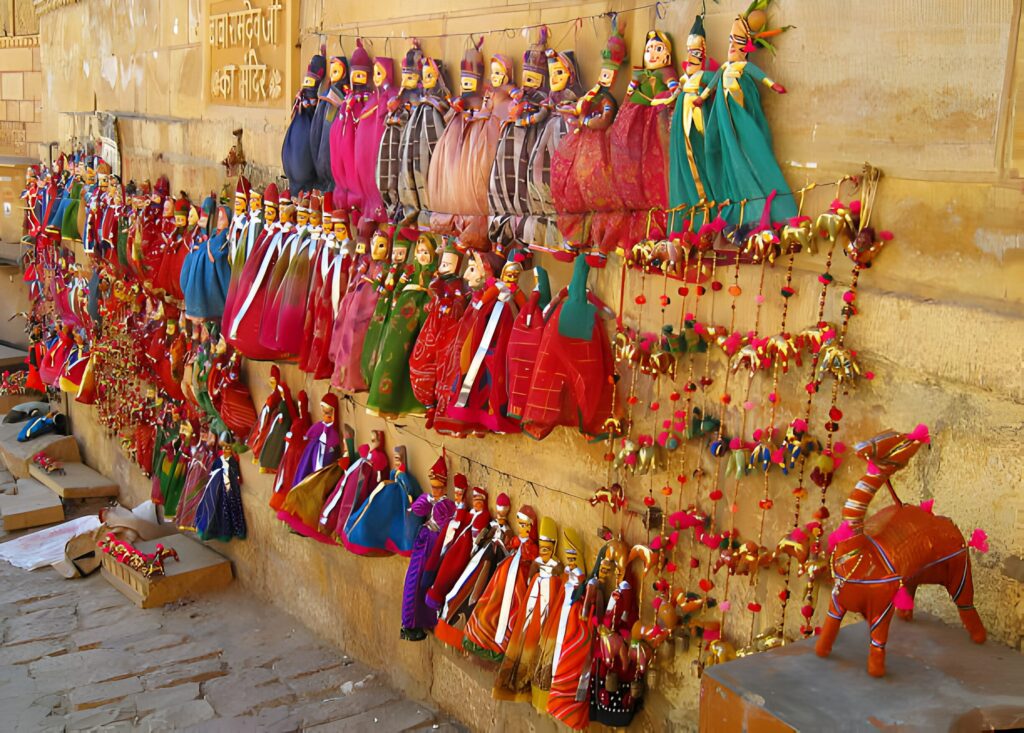
Walk through Jaisalmer’s markets and you’ll see how much of the region’s craft is textile. Barmer is known for ajrakh block printing and dense embroidery. Appliqué and mirror work turn up on everything from wall hangings to camel trappings.
Then there’s pattu. It’s a handwoven woollen fabric made by Meghwal weavers in Jaisalmer and Barmer, with bold geometric patterns built up thread by thread on the loom. For generations it was an everyday shawl or blanket for desert winters, the kind of thing you’d find in any village home. Machine made blankets have made it rarer. When Fort Rajwada named its bar Pattu, it was nodding to exactly this local tradition.
Hotels matter here because of scale. A family buys one bedspread. A hotel with 90+ rooms and 9 palace suites furnishes every one of them, and as a five star hotel and restaurant it replaces cushion covers, throws and curtains regularly. Choosing hand-block printed textiles and traditional pieces over factory stock keeps looms and printing tables busy.
Fort Rajwada’s rooms use hand-block textiles and antique woods, and the Sheesh Mahal Suite takes its name and inspiration from the mirror-work halls of Rajput palaces, one of the most recognisable crafts in jaisalmer and Rajasthan.
Recipes that would be easy to lose
Desert cooking grew out of scarcity. Water was precious and fresh vegetables were hard to find for much of the year, so the region learned to cook with what lasted: millet, gram flour, lentils, ghee and dried produce like ker berries and sangri beans. Sangri comes from the khejri, Rajasthan’s state tree, which is why ker sangri tastes of the Thar in a way few dishes taste anywhere.
Plenty of these dishes are slow. Baati was traditionally baked in the embers of a fire. Laal maas needs time and the right dried red chillies to get its colour and depth. A good kadhi or gatte ki sabzi isn’t hard, but it’s fiddly. Home kitchens have understandably moved towards shortcuts, and that’s how recipes start to fade.
A hotel kitchen that cooks these dishes properly, every day, for guests from all over the world, keeps the methods in practice and gives younger cooks a reason to learn them. Fort Rajwada’s Sonal restaurant focuses on Rajasthani cuisine made with organic, local produce, and it’s the place to order dal baati churma or laal maas the way they’re meant to taste.
What preserving culture looks like, at a glance
| Tradition | Where it comes from | How a palace hotel keeps it going |
| Sandstone carving | Jaisalmer’s stone-carving families | Building in local stone, with ongoing repair work |
| Jharokhas and courtyards | Desert architecture built for shade and airflow | Keeping traditional forms in new construction |
| Manganiyar and Langa music | Hereditary musicians of Jaisalmer and Barmer | Regular paid evenings, weddings and events |
| Pattu weaving | Meghwal weavers of Jaisalmer and Barmer | Buying and displaying handwoven pieces |
| Block printing and mirror work | Barmer and wider Rajasthan | Furnishing rooms with handmade textiles |
| Desert cuisine | Rajput and village kitchens of the Thar | Cooking traditional recipes the slow way |
How to tell if a hotel is preserving culture or just staging it
Not every “cultural evening” is the same, and you can usually tell the difference within a day. A few things to look for:
- The musicians are introduced by name and community, and they’re playing more than a short tourist set.
- The menu has regional dishes every day, not only on a buffet night, and the staff can tell you where a dish comes from.
- The textiles and crafts in the rooms are clearly handmade, and someone can tell you where they were made.
- The building itself uses local stone and local forms. A carved gate in front of a modern block doesn’t count.
- Many of the staff are from the region and are happy to talk about it.
You’ll notice none of these have much to do with thread counts. They tell you whether the culture you’re seeing has roots.
Making the most of it during your stay
You’ll get far more out of a palace hotel’s culture if you slow down. Three nights gives you time for the fort and the havelis, an evening out in the dunes and at least two unhurried evenings at the hotel itself, which is when the music, the food and the building come together.
If you’d like to know what all this feels like from the guest’s side, from the welcome at the door to being called Hukum at dinner, our guide to traditional Rajasthani hospitality covers it in detail.
Frequently asked questions
How do luxury hotels in Jaisalmer preserve traditional Rajasthani culture?
They build and maintain their properties in local sandstone using traditional carving, they hire Manganiyar and Langa musicians for regular performances, they furnish rooms with regional textiles like pattu and block prints, and they keep traditional desert recipes on their menus.
Who are the Manganiyars of Jaisalmer?
They’re hereditary Muslim musicians from Jaisalmer and Barmer who sang for Rajput patron families for generations. Their music is passed down orally, and the kamaicha, a bowed string instrument, is closely tied to their tradition.
What is pattu weaving?
Pattu is a handwoven woollen textile made by Meghwal weavers in Jaisalmer and Barmer. It’s known for its bold geometric patterns and was traditionally used for shawls and blankets during desert winters.
Why is Jaisalmer built from yellow sandstone?
The stone is quarried locally, it’s soft enough to carve in fine detail, and thick stone walls help keep buildings cool in the desert heat. It’s also what gives Jaisalmer its name as the Golden City.
Does staying at a palace hotel support local artisans?
It can, and often does. Hotels are among the biggest regular employers of local musicians, carvers and craftspeople in Jaisalmer, especially those that build in traditional styles and buy handmade furnishings.