
Most people give Jaisalmer two days. It’s usually not enough time because the city’s best sights sit in three quite different zones. There’s the fort and old town, which you’ll cover on foot. There’s the ring of lakes, cenotaphs and abandoned villages just outside the city. And then there’s the desert itself, an hour west, where the dunes start.
We’ve put this list together from what our guests actually ask us at the front desk, and from what they tell us was worth it when they get back. It’s roughly in the order we’d suggest you see things, with a sample itinerary at the end.
Getting here is simpler than a lot of people expect, by the way. Jaisalmer has direct flights from Mumbai and Delhi during the season, and road and rail links via Jodhpur, Jaipur and Ahmedabad are well used. So you don’t need to lose a whole day to travel.
1. Jaisalmer Fort (Sonar Qila)
Start here. Everything else in the city makes more sense once you’ve stood on its walls.
Rawal Jaisal founded the fort in 1156, and it’s one of the very few forts in the world where people still live inside. Somewhere around a quarter of the old town’s population has homes, shops and guesthouses within its walls. That’s why it doesn’t feel like a museum. You’ll dodge scooters, cows and schoolkids in the lanes, and someone’s usually hanging washing off a carved balcony above you.
The yellow sandstone is what gives it the name Sonar Qila, or Golden Fort. Late afternoon is when it earns that name, so if you can, walk the ramparts after four. It’s part of the Hill Forts of Rajasthan UNESCO World Heritage listing, alongside Chittorgarh, Kumbhalgarh and others.
Inside, don’t skip the Raj Mahal (the old royal palace, now a museum) or the Jain temples.
How long: three to four hours if you’re doing it properly. Wear flat shoes. The stone gets polished smooth and slippery near the gates.
2. Jain Temples Inside the Fort
There are seven Jain temples tucked into the fort, built between roughly the 12th and 15th centuries, and the carving is some of the finest in Rajasthan. The Parshvanath temple is the one most people head to first.
A few things to know. They keep limited visiting hours for non-worshippers, usually in the morning, so plan the fort around them. Leather items like belts and wallets aren’t allowed inside, and you’ll leave your shoes at the entrance. Dress modestly.
How long: forty-five minutes to an hour.
3. Patwon Ki Haveli
If you only see one haveli, make it this one. It’s actually a cluster of five mansions, built in the early 1800s for a wealthy merchant family, and the stone facades are carved so finely they look like lace.
The first haveli in the row is set up as a museum, and it’s the one that gives you a sense of how these families lived. Look up as you walk the lane. The jharokhas (overhanging balconies) are the whole point.
How long: about an hour.
4. Salim Singh Ki Haveli
You’ll spot it by the roof, which sweeps up and out in a curve people often compare to a peacock. Salim Singh was the prime minister of Jaisalmer state in the early 19th century, and the house was built to be seen from a long way off.
It’s smaller than Patwon Ki Haveli and you’ll get through it quickly, but it sits just below the fort so it’s easy to fold in.
How long: thirty to forty minutes.
5. Nathmal Ki Haveli
The story here is a nice one. Two brothers carved the facade, one working on each side, and they didn’t copy each other. So the two halves look almost the same until you stand in front and start noticing the differences. Kids love spotting them.
Parts of it are still lived in, so what you can see inside varies.
How long: twenty to thirty minutes.
6. Gadisar Lake
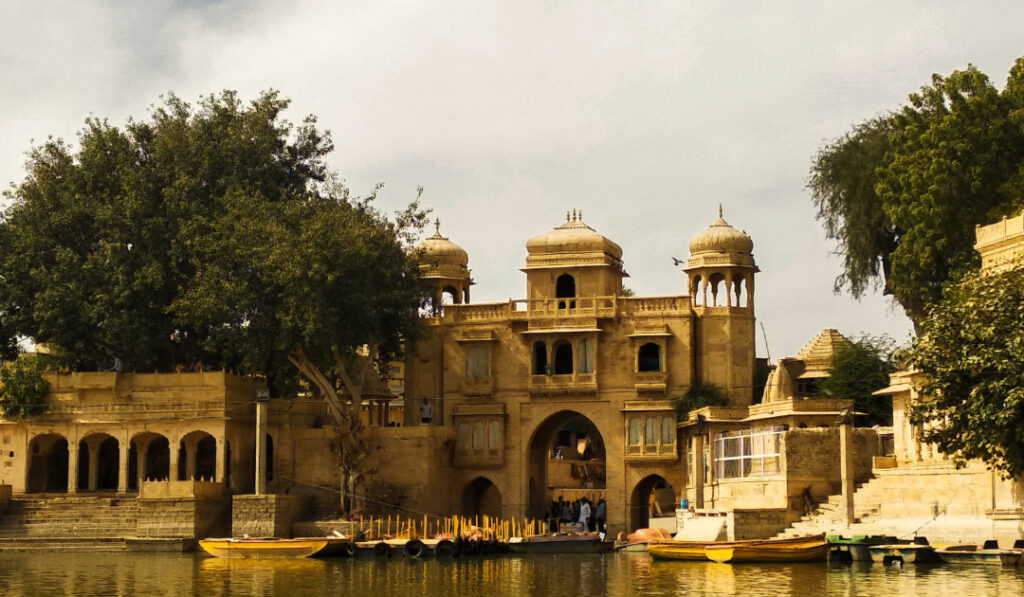
Gadisar was the city’s water supply for centuries, and it’s still the prettiest spot in Jaisalmer at sunrise. The ghats, the small shrines on the water and the carved Tilon Ki Pol gateway make it very photogenic, and there’s pedal and rowing boats if you want to get out on it.
We’ve written a full Gadisar Lake guide covering boating, timings and the history, so we’ll keep it short here. Go early. By mid-morning the light’s flat and the crowds are in.
How long: an hour, or two if you’re boating.
7. Bada Bagh
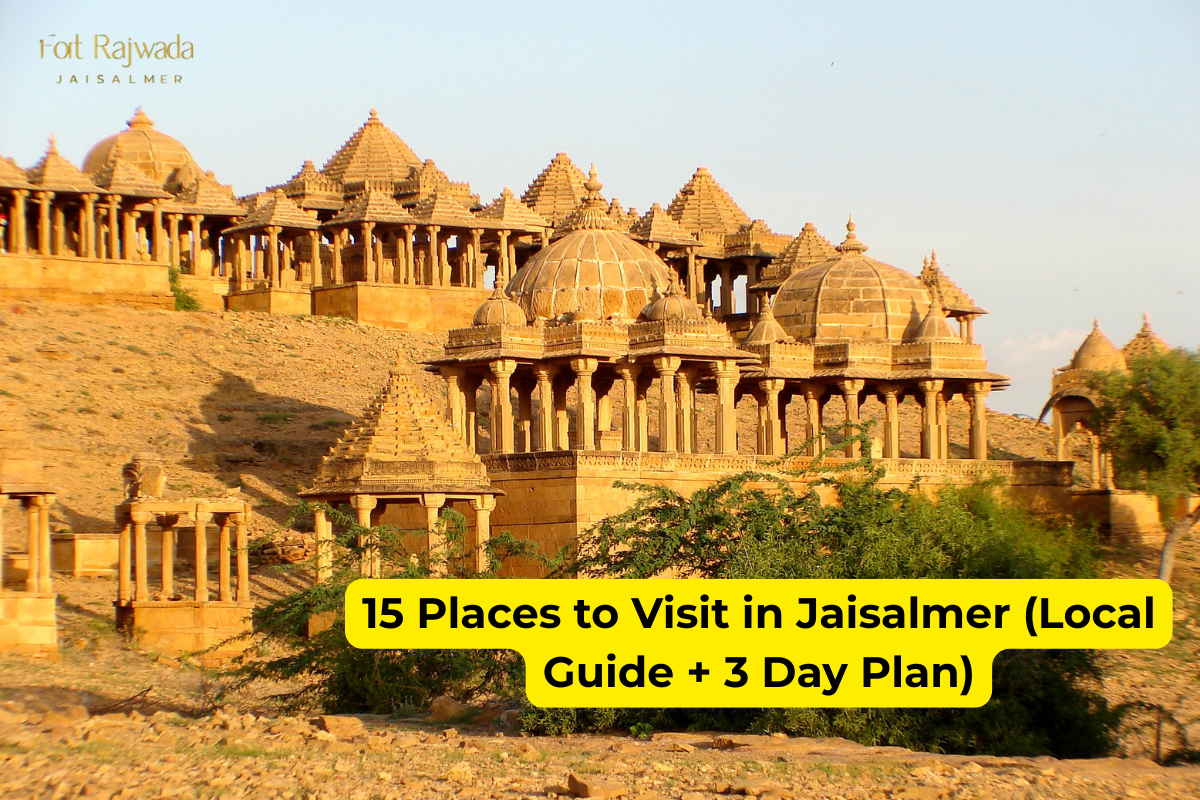
About six kilometres north of the city, Bada Bagh is a hillside of royal chhatris (cenotaphs) built for the rulers of Jaisalmer. Rows of domed pavilions stand against open desert, and with the wind turbines on the ridge behind them it’s one of the strangest and most striking views in the district.
Sunset’s the popular time. Sunrise is quieter and just as good.
How long: forty-five minutes.
8. Vyas Chhatri
If Bada Bagh’s too far out for your schedule, Vyas Chhatri gives you a similar look closer in. It’s a cluster of sandstone cenotaphs on a rise at the edge of town, and it’s where a lot of locals go to watch the sun set behind the fort.
How long: thirty minutes, timed for sunset.
9. Kuldhara Village
Kuldhara’s an abandoned village about 18 kilometres west of the city, and it’s one of the most visited places around Jaisalmer. It was once home to Paliwal Brahmin families, and the local legend says they all left in a single night and put a curse on the place so no one could ever settle there again.
Whatever you make of the legend, the village itself is worth seeing. You walk through roofless stone houses, lanes and a small temple, and it’s eerily quiet. Some of the houses have been restored so you can see how they were laid out.
It sits on the road to Sam, so it pairs nicely with a dune evening. Go in the afternoon. The site closes at sunset.
How long: forty-five minutes to an hour.
10. Khaba Fort
Khaba’s another abandoned settlement, a bit further out than Kuldhara and far less crowded. There’s a small fort on a hill with a museum of fossils and local artefacts, and the view over the ruined village below is excellent. A lot of people skip it, which is exactly why we like it.
How long: an hour.
11. Sam Sand Dunes
This is the desert people come to Jaisalmer for. Sam is roughly 40 to 45 kilometres west of the city, and it is the place where you’ll find camel rides, jeep safaris, dune bashing and the big evening cultural programmes at the camps.
Sam Sand Dunes guide written by fort rajwada covers safaris, camps and timing in detail. The short version is to leave the city by three in the afternoon so you’re on the dunes well before sunset.
12. Khuri Sand Dunes
Khuri’s the quieter alternative to Sam Sand Dunes, about 45 kilometres southwest. The dunes are smaller but there’s far less commercial activity, and the village itself, with its mud-walled houses, feels more like the Thar people imagine. If you’re staying more than two days, or you’ve done Sam before, it’s worth looking for. Khuri sand will give you a different experience than the Sam.
13. Desert National Park
This is a big protected area spread across Jaisalmer and Barmer districts, and it’s one of the last strongholds of the Great Indian Bustard. You’ll also see chinkaras, desert foxes and a lot of raptors in winter. The Sudasari area is the usual entry point.
It’s for wildlife and birding people really. Go early in the morning with a local guide who knows where to look.
How long: half a day.
14. Jaisalmer War Museum
On the Jaisalmer to Jodhpur highway, the War Museum is built around the story of the 1971 Battle of Longewala, where a small Indian company held off a Pakistani armoured column through the night. There’s a light and sound show, captured tanks and a well-put-together hall of honour.
Families tell us this is the one their kids remember. It’s an easy stop on your way in or out of the city.
How long: an hour to ninety minutes.
15. Tanot Mata Temple and Longewala
These two are a proper day trip, around 120 kilometres from the city near the border. Tanot’s a temple run by the BSF with a remarkable story from the 1965 war, and Longewala’s the actual battlefield from 1971. We’ve written a separate Tanot Mata Temple and Longewala guide with routes, timings and permit details.
A Few More If You’ve Got Time
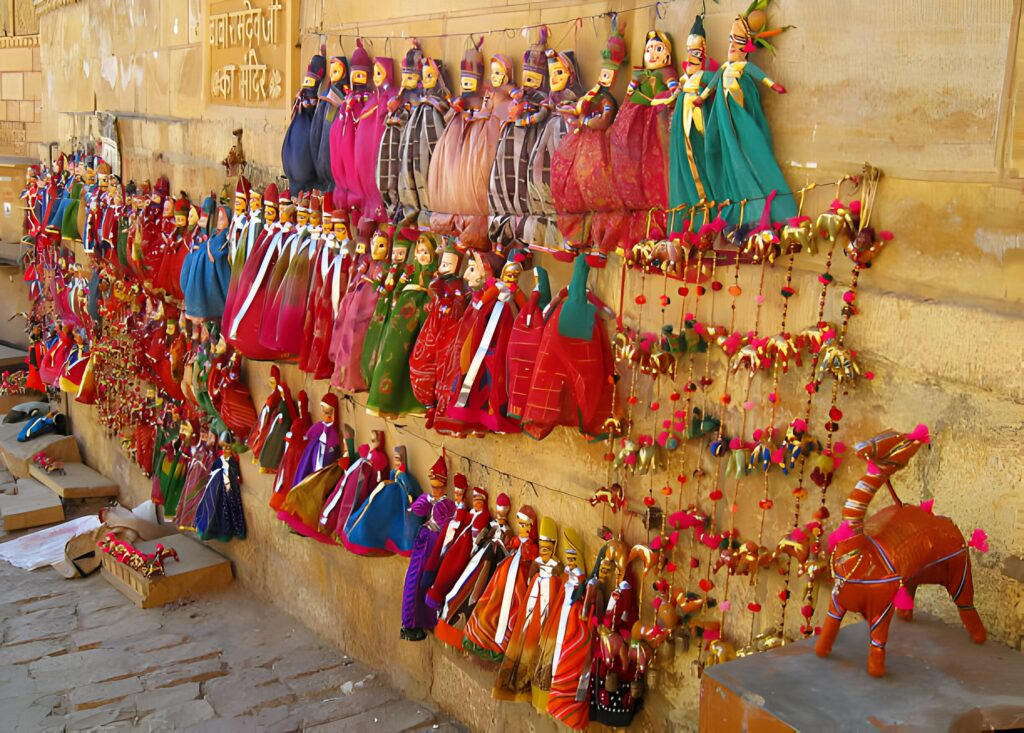
Lodurva, about 15 kilometres out, was Jaisalmer’s capital before the fort was built and has a beautiful Jain temple. Amar Sagar is a small lake with a palace and temple on the way there. And the Desert Culture Centre near Gadisar runs an evening puppet show that’s good fun if you’re travelling with children.
Jaisalmer Sightseeing: A Simple 3 Day Plan
Day 1: The Old City
- Sunrise at Gadisar Lake
- Breakfast, then Jaisalmer Fort and the Jain temples through the morning
- Lunch in the old town
- Patwon Ki Haveli, Salim Singh Ki Haveli and Nathmal Ki Haveli in the afternoon
- Sunset at Vyas Chhatri or from a fort rooftop
Day 2: Out Into the Desert
- Bada Bagh early, while it’s quiet
- War Museum late morning if you’re keen
- Rest through the hottest part of the day
- Leave around 2:30 for Kuldhara
- On to Sam for sunset, a camel or jeep ride and the evening programme
- Back to the city, or stay the night at a camp
Day 3: The Border and a Slow Evening
- Leave early for the Longewala War Memorial
- Carry on to Tanot Mata Temple for darshan and the BSF museum
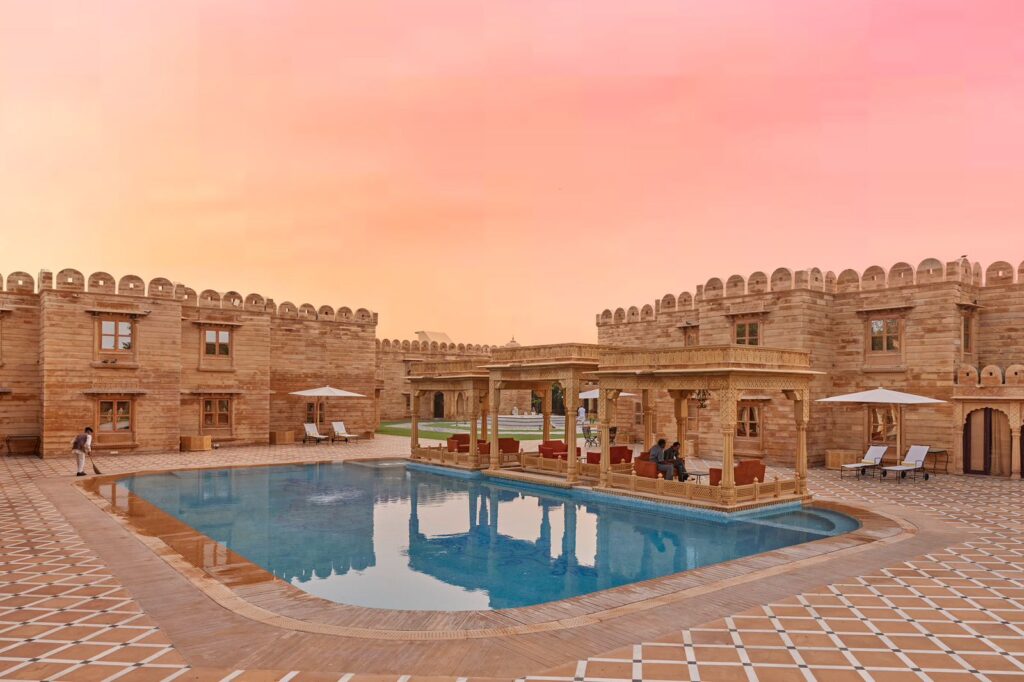
- Back in the city by late afternoon, with time for the pool or a last walk through the bazaar
- Dinner at your hotel. Order the Dal Baati Churma and the Laal Maas
- Stay on for the evening’s folk music and dance
We’d give Jaisalmer three nights. It lets you see everything on this list without rushing, and it leaves your evenings free, which matters more than people think. The food at the good hotels in the city is a big part of the trip. Dal Baati Churma and Laal Maas are to die for, and you shouldn’t leave without trying both. Evenings at the better hotels, Fort Rajwada included, come with local singers and dancers performing, so dinner often turns into the best part of the day.
Best Time to Visit Jaisalmer
October to March is the season. Days are warm and pleasant, and nights in December and January get properly cold, especially out on the dunes, so pack a real jacket. The Desert Festival usually falls in February, and the city gets busy and fun around it.
April to June is very hot. You can still visit, but you’ll want to do everything early in the morning and after five. The monsoon months are quieter and cheaper, and the desert turns surprisingly green after a good rain.
Getting Around
The fort and havelis are best on foot. Cars can’t go all the way up into the fort anyway. For everything outside the old city, a hired car with a driver is the easiest and best option. Autos are best for the short travels around the town.
Best option for stay.
Where you stay changes how the trip feels to you. Inside the fort you’re right in the thick of it, though rooms are small and cars can’t reach you. Guesthouses below the fort put you within walking distance of most sights. Desert camps are about the experience more than comfort.
Fort Rajwada is a palace hotel on the Jodhpur to Barmer Link Road, a short drive from the old city and the railway station and the airport. We’ve been welcoming guests since 1998 and reimagined our property in 2021. What most of our guests like about our luxury five star hotel is having a calm base with a pool and good food to come back to after a day in the heat, while still being close enough to get to Gadisar for sunrise without a painful early start.
Our team is happy to help plan your sightseeing, book cars and sort safaris. You can reach reservations on +91-9828049555 or at reservations@fortrajwada.com.
Frequently Asked Questions
How many days are enough for Jaisalmer?
We’d suggest three days and three nights. That covers the main places to visit in Jaisalmer, an evening on the dunes at Sam and the day trip to Tanot and Longewala. It also leaves your evenings free for Rajasthani food and folk music back at your hotel.
What’s the most famous tourist place in Jaisalmer?
Jaisalmer Fort. It’s the reason the city’s called as the Golden City of India, and it’s still lived in, which makes it quite unlike most forts in India.
Can I cover Kuldhara and Sam Sand Dunes on the same day?
Yes, and you should. Kuldhara’s on the road to Sam, so visit in the afternoon and carry on to the dunes for sunset.
Is Jaisalmer good for families?
Very. Kids tend to love the camel rides, the War Museum, the puppet show and spotting the differences on Nathmal Ki Haveli. Just plan around the midday heat.
What should I wear for sightseeing in Jaisalmer?
Light, breathable clothes that cover your shoulders and knees for the temples, flat shoes for the fort, a hat and sunscreen. In winter, add warm layers for the evenings.
Timings and access at several sites change from season to season. We update this guide regularly, but please confirm details locally before you go.